Discover what a Legal AI Assistant is, how it automates contract review, legal research, compliance, and boosts legal operations efficiency.
Modern corporate legal departments face a quiet crisis. In-house teams handle a growing volume of corporate contracts, procurement agreements, and regulatory rules every day. Business speeds continue to accelerate. Corporate budgets face systematic pressure. Headcount freezes force general counsels to complete double the volume of work with identical or reduced resources. This operational math simply does not balance.
A professional legal AI assistant offers a path out of this administrative friction. It is not a generalized search program or a generic text chatbot. It is a specialized legal operating system designed to read, analyze, and act on legal language. This exhaustive guide breaks down the architecture of legal AI assistants and demonstrates how they are transforming enterprise legal operations.
What Is a Legal AI Assistant?

A legal AI assistant is a specialized software platform built to operate with legal precision. It uses artificial intelligence technologies, including natural language processing and machine learning models trained on legal data, to support legal professionals.
Unlike general AI, it is built to understand the nuances of legal language, workflows, and documents. This tool handles tasks that typically take hours of manual work. It reviews contracts for key terms, drafts standard clauses, summarizes lengthy legal documents, and conducts case law research.
It acts as a digital partner, augmenting lawyers’ skills rather than replacing them. The platform supports lawyer judgment with data-driven insights and authoritative citations. This combination strengthens legal outcomes and client trust.
How Is Legal AI Different from Regular AI Tools?
Generic AI tools, like broad chatbots or language models, provide wide-ranging answers. They often lack precision in legal contexts. They may misinterpret legal jargon or produce inaccurate results, especially without domain-specific training. This structural mismatch introduces unacceptable transaction risk.
How do professional legal AI assistants maintain accuracy? They train on vast amounts of legal data, including statutes, case law, and contracts.
They specialize in legal reasoning and terminology. This focus improves reliability and reduces hallucinations, which are false or misleading outputs without citations. For example, while a general AI might generate vague contract language, a legal AI assistant drafts clauses compliant with company playbooks and jurisdictional rules.
Why Corporate Legal Teams Are Overwhelmed
Corporate legal departments operate in a state of constant reaction. They receive contract reviews from sales teams, regulatory queries from product divisions, and dispute filings from operational units. This unstructured intake turns highly paid corporate attorneys into manual administrative processors. The daily reality of the in-house lawyer is defined by chasing files rather than delivering strategic guidance.
The Problem with Handling Documents Manually
Every legal request begins with an intake process. A business teammate drafts an agreement or receives a third-party contract. They send this document to the legal team, usually through a basic email inbox or a shared corporate messaging channel.
Why does this manual workflow persist in modern enterprises? It persists because legacy software cannot read the actual context of an incoming document.
Lawyers must open every email to understand what the business unit is trying to achieve. They must search for missing transaction details. They must track down missing signature pages and ask for context on pricing terms. This manual back-and-forth communication takes days before actual legal review can even begin.
Attorneys spend hours on categorization and task assignment. This constant administrative triage drains energy and delays business velocity. It blocks high-value specialists from addressing complex corporate risk.
The Hidden Cost of Switching Between Tools
Legal information is highly fragmented. Corporate agreements sit across email outboxes, local hard drives, cloud directories, and localized document storage pools. When an attorney needs to verify past positions on a specific clause, they must manually search multiple platforms.
This layout forces professionals to toggle between different environments constantly. They must leave their drafting document to open an old folder. They must run basic searches, open dozens of PDFs, and manually copy text.
What is the real cost of this disjointed setup? This context-switching carries a high cognitive cost that directly reduces overall drafting quality.
A study highlighted in independent legal industry guides indicates that administrative tasks consume up to forty percent of a lawyer's typical workday. This manual process is no longer sustainable. Corporate attorneys lose valuable hours to pure information retrieval. The loss of focus introduces unnecessary risk to transactions.
Why Old Legal Software Isn't Working Anymore
Large corporations have invested millions of dollars in traditional legal technology platforms over the past two decades. Yet, legal operations remain slow. Business teams still complain about the legal department being a bottleneck. The reason is structural. Traditional enterprise software was built to store files, not to comprehend them.
Why Regular Document Storage Falls Short
Most traditional Document Management Systems (DMS) act as glorified digital filing cabinets. They store millions of PDFs, Word files, and scanned documents. They rely on basic manual tagging, folder hierarchies, and keyword search indexes to organize corporate data.
What happens when legal teams rely on standard cloud storage? Files become dead data that requires manual opening every single time.
If a general counsel wants to know if fifty past vendor contracts contain a specific liability limit, a standard DMS cannot answer. The platform only knows that the document exists. It does not know what the clauses actually mean.
Attorneys must open each contract one by one. They must read thousands of pages to extract a single metric. The storage is digital, but the actual intelligence work remains manual.
Related Articles: Top Legal AI Assistant for In-House Legal Teams in 2026
The Real Cost of Using Too Many Separate Tools
Many legal teams attempt to solve these issues by purchasing multiple niche point solutions. They buy one dedicated tool for electronic signatures. They install a second program for basic legal research. They deploy a third platform for contract review.
This approach creates a heavy tax of tool fragmentation. These isolated applications do not exchange data. Attorneys must master multiple user interfaces. They must copy and paste data across different screens constantly.
How does tool fragmentation impact the broader organization? It forces IT departments to manage multiple complex security integrations.
Software maintenance budgets expand while actual user adoption rates plummet. Instead of streamlining corporate workflows, this fragmented environment adds fresh layers of operational friction.
Core Functions and Capabilities in Legal Practice
A professional legal AI assistant does not simply search for keywords or summarize basic text. It reads legal language, reasons through logical boundaries, and executes multi-step workflows. It offers a suite of functions tailored to daily legal work.
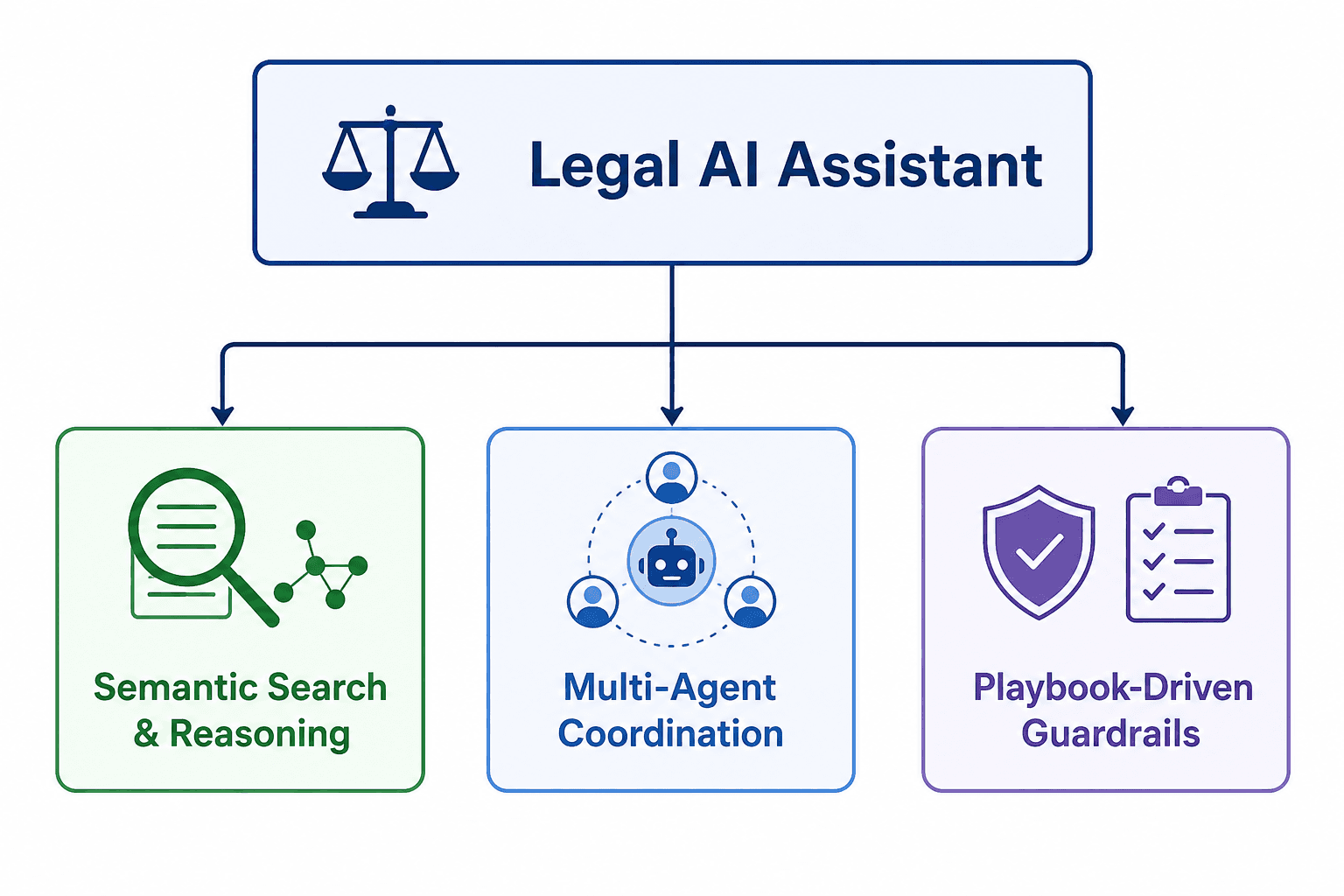
Key capabilities include:
Contract review and redlining: Automatically highlight deviations, risks, and missing clauses.
Document drafting: Generate standard legal agreements and documents using domain-specific generative AI models.
Legal research: Conduct targeted searches across statutes, case law, and regulatory filings.
Risk detection and compliance monitoring: Flag potential regulatory, tax, or contractual issues.
Document summarization: Extract key points, performance obligations, and deadlines from lengthy files.
Workflow automation: Integrate with case management systems to trigger tasks, approvals, and notifications.
These capabilities reduce time spent on routine tasks while improving contract accuracy and compliance. Legal AI assistants provide transparency and allow lawyers to maintain full control over final outputs.
Related Articles: Top Legal AI Assistant for Litigation Counsel 2026
The Technology Behind Legal AI Assistants
Legal AI assistants rest on advanced technologies built for the legal domain. These include natural language processing, machine learning models trained on legal data, and workflow automation features. Together, they enable the assistant to understand, analyze, and generate legal content with precision.
Natural Language Processing and Legal Language Understanding
Natural language processing (NLP) forms the foundation of how legal AI assistants interpret text. Unlike general NLP models, those used in legal AI are trained on domain-specific corpora. These include contracts, statutes, case opinions, and legal briefs.
This training enables the assistant to grasp complex legal syntax, jargon, and concepts. For instance, it can differentiate between "indemnify" and "hold harmless" clauses. It also recognizes jurisdictional references instantly.
Can the assistant extract specific data points across multiple documents? Yes, NLP powers features like contract data extraction, clause classification, and interactive question-answering over legal datasets.
The assistant scans thousands of pages to find relevant case law or identify risk flags. Some platforms use hallucination-free answers with citations, linking AI-generated outputs to authoritative sources. This transparency bolsters user trust and supports lawyer judgment.
How AI Learns from Legal Documents
Machine learning (ML) algorithms underpin the assistant’s ability to learn from data and improve over time. These models train on annotated legal documents. This teaches the system to recognize patterns like clause types, obligations, and risk factors.
Domain-specific AI ensures that ML models do not generalize poorly, which often happens with large language models trained on broad consumer datasets.
Many legal AI assistants use generative AI capabilities to draft contracts or legal memos. This generative drafting leverages large language models fine-tuned on legal text. Meanwhile, ML supports predictive analytics such as litigation risk scoring or contract breach probability. These insights help legal teams prioritize work and reduce exposure.
Workflow Automation and Contextual Adaptation
Beyond document analysis, legal AI assistants embed into complex legal workflows. Workflow automation connects AI outputs with task management, notifications, and compliance tracking. For example, after AI flags a risky clause, it can trigger a review task assigned to a lawyer or update the contract repository with version control.
How does the assistant adapt to a specific firm or corporation? Contextual adaptation means the assistant learns firm-specific rules, preferred clauses, and playbooks.
This customization sharpens contract accuracy and standardization across teams. Integration with document management systems and contract lifecycle management platforms enables centralized, shareable documents. This ensures consistent use of AI insights across the entire enterprise.
Integration with Legal Practice and Document Management Systems
For practical use, legal AI assistants integrate closely with existing legal practice management systems (LPMS) and document management systems (DMS). This integration ensures that AI tools work within familiar workflows. It stops users from being forced to switch platforms.
For example, some assistants embed directly into Microsoft 365 or Outlook. This allows lawyers to conduct legal research or draft documents without leaving their email client. Others connect with contract lifecycle management platforms to automate contract review and tracking across the contract life cycle.
Seamless integration also supports data privacy and security by respecting existing access controls and audit trails. Many legal AI assistants comply with enterprise standards like SOC 2 Type II certification and GDPR, ensuring client confidentiality. This approach helps firms adopt AI without disrupting day-to-day legal work or risking data breaches.
Related Articles: Legal AI Adoption: A Strategic Guide for In-House Counsel
Why Legal AI Assistants Are Transforming Legal Work
Legal AI assistants reshape how legal teams handle their daily tasks. They improve speed, reduce errors, and enable teams to scale their work without enlarging headcount. These changes have broad implications for law firms, in-house legal departments, and legal service providers.
Enhancing Speed and Accuracy in Legal Tasks
By automating contract review, legal research, and document drafting, AI assistants sharply cut turnaround times. What once took hours or days now completes in minutes. For example, AI contract review identifies deviations from standard terms instantly, speeding up negotiations. Document summarization condenses thousands of pages into clear obligation summaries rapidly.
Does this speed expansion come with a trade-off in accuracy? No, accuracy actually improves because AI tools consistently apply rules and detect errors that humans might miss.
This reduces risks of contract inaccuracies or compliance lapses. Research by the Legal Technology Hub found that firms using AI saw up to a forty percent reduction in contract review time while improving error detection rates.
Reducing Cognitive Load and Human Error
Legal professionals face cognitive overload when juggling complex cases and voluminous documents. AI assistants relieve this burden by handling routine, repetitive work. This shift lets lawyers focus on high-value tasks requiring judgment, such as strategy and client counsel.
Reducing human error is critical in high-stakes legal matters. AI tools flag inconsistencies, missing clauses, or conflicting terms before contracts finalize. They support lawyer judgment with data-driven insights and authoritative citations. This combination strengthens legal outcomes and client trust.
Enabling Scalability and Consistency Across Legal Teams
Legal AI assistants help firms scale operations without proportional staff increases. Teams can handle more contracts, cases, or research projects with the same resources. Automated workflows and standardized document drafting promote consistency across departments and offices.
How do automated assistants support modern distributed offices? They enable secure, cross-platform collaboration for remote and hybrid work models.
AI tools embedded in platforms like Microsoft 365 or custom workflow builders keep teams aligned. In-house legal teams gain centralized visibility into contract life cycles and compliance status. This visibility improves overall corporate governance and risk management.
Related Article: Why Legal Teams Struggle to Scale Without Legal AI Assistant
Key Functionalities Driving Practical Benefits
Legal AI assistants offer several core functionalities that deliver measurable value. These features address common pain points in legal operations and elevate firm productivity.
Automated Contract Drafting and Redlining
Automated contract drafting uses generative AI to create initial drafts based on templates and firm rules. This reduces time spent on standard agreements like master services agreements or non-disclosure agreements. AI redlining tools compare contract versions, highlight changes, and suggest edits. This speeds up negotiation cycles and improves contract accuracy.
Custom playbooks embedded in the AI ensure compliance with company policies and regulatory requirements. Lawyers maintain control by reviewing and approving AI-generated content before finalization. This approach balances automation with lawyer judgment.
Risk Detection and Compliance Monitoring
AI legal assistants scan contracts and documents to identify potential risks and compliance issues. They flag clauses that deviate from accepted standards, highlight regulatory gaps, and monitor deadlines for obligations. This reduces exposure to legal, regulatory, and tax risks.
Are these compliance checks static or continuous? Some platforms provide real-time compliance monitoring linked directly to company policies and external regulations like GDPR.
This ongoing oversight supports proactive risk management. Risk flagging also integrates with workflow automation, prompting timely reviews and updates.
Related Articles: How to Use AI in Compliance Monitoring in 2026
Document Summarization and Obligation Tracking
Summarizing lengthy legal documents is time-consuming. AI assistants extract key points, deadlines, and obligations into concise summaries. This helps legal teams quickly understand contract terms and compliance duties.
Obligation tracking tools monitor performance deadlines, renewal dates, and deliverables. They send calendar updates and notifications to responsible parties. This functionality supports better contract lifecycle management, reducing missed deadlines and improving client service.
Implementation Considerations for Legal AI Assistants
Adopting legal AI assistants requires careful planning to maximize benefits and minimize risks. Firms must address integration, security, and user readiness.
Seamless Integration with Existing Work Environments
Successful AI adoption depends on smooth integration with legal practice management systems, document repositories, and communication platforms. This avoids workflow disruption and data silos. Integration should support single sign-on, secure shared spaces, and cross-platform consistency.
Vendors offering APIs and connectors ease deployment. For example, AI assistants that embed in Microsoft 365 or CLM platforms allow lawyers to work within familiar environments. Integration also supports compliance by respecting existing access controls and audit logs.
Data Privacy, Security, and Ethical Use
Legal data is highly sensitive. AI assistants must meet enterprise-grade security standards, including encryption, SOC-compliant infrastructure, and privilege protection. Many solutions hold SOC 2 Type II certification and comply with GDPR.
Ethical use guidelines ensure AI outputs remain transparent and accountable. Lawyers retain ultimate control over decisions, supported by AI’s transparent citations to controlling authority. Secure, ethical systems build trust among clients and regulators.
Training, Change Management, and Overcoming Data Bias
Effective training is essential for user adoption. Legal teams must understand AI capabilities, interpret results accurately, and integrate AI into workflows. Structured onboarding and ongoing education foster trust and maximize efficiency gains.
Change management addresses resistance by highlighting AI’s role as an assistant, not a replacement. Clear communication about benefits and limitations helps lawyers embrace the technology. Firms often start with pilot programs and scale gradually.
How do we prevent the AI from amplifying historical bias? Firms must audit data sources, clean document repositories, and retrain models as needed.
Domain-specific AI reduces generalization errors common in broad language models. Regular evaluation of AI accuracy and fairness supports ongoing improvements. Some vendors provide tools for model accuracy evaluation and hallucination detection.
Practical Use Cases in Legal Operations
Legal AI assistants find real-world application across multiple legal functions. These use cases demonstrate tangible improvements in efficiency and accuracy.
Contract Lifecycle Management Acceleration
AI assistants automate many contract lifecycle management steps. They extract contract data, flag deviations during review, monitor renewal dates, and generate obligation reports. This accelerates contract negotiation and execution while reducing errors.
Legal teams gain centralized views into contract repositories and can apply custom playbooks consistently. Automated alerts for deadlines and risk flags support proactive management.
Streamlining Legal Research and Case Analysis
AI-powered legal research tools conduct deep legal data extraction and case law evaluation rapidly. They identify relevant statutes, precedents, and regulations tailored to firm practice areas. This supports authoritative legal analysis and faster memo drafting.
Some platforms integrate with courtroom assistants for real-time argument recall and deposition insights. These tools enhance litigation strategy and trial preparation.
Related Articles: Why Use AI for Legal Research in 2026 Legal Teams
Supporting Litigation Preparation and Due Diligence
During litigation, AI assistants generate interactive discovery timelines, extract evidentiary facts, and summarize medical records or witness outlines. This automation sharpens case strategies and reduces manual workload.
AI also accelerates due diligence by bulk-analyzing legal documents and highlighting key risks. This supports faster transactions and more thorough compliance checks.
Why Lawxy AI Is a Smart Choice
Lawxy offers a tailored AI assistant designed specifically for legal professionals. It combines domain-specific AI with workflow compatibility to drive measurable efficiency.
Unique Features Tailored to Legal Professionals
Lawxy leverages natural language processing and machine learning models fine-tuned on legal data. It provides hallucination-free answers with citations, ensuring reliable outputs. The platform supports complex legal workflows like contract lifecycle management, risk detection, and document drafting automation.
Workflow Compatibility and Customization
Lawxy integrates seamlessly with leading practice management and document management systems. It offers custom playbooks and workflow builders to align with firm policies. This flexibility supports adoption across diverse legal teams and practice areas.
Clients report up to thirty to forty percent reductions in contract review time and improved consistency using Lawxy. The platform’s secure infrastructure meets enterprise privacy standards, supporting compliance and trust. Lawxy’s focused legal AI tools empower lawyers to scale work efficiently while maintaining control.
Competitive Evaluation Matrix
Understanding the functional differences between available tools helps organizations avoid software fragmentation. This matrix compares specialized, native systems against general enterprise tools.
Feature | Lawxy | Generic AI Chatbots | Legacy Legal Tech |
|---|---|---|---|
Domain-Specific Legal AI | Yes | No | No |
Contract Drafting Automation | Yes | Limited | No |
Integration with CLM Platforms | Seamless | None | Poor |
Hallucination-Free Citations | Yes | No | No |
SOC 2 Type II Certification | Yes | Varies | Varies |
Custom Playbooks Support | Yes | No | No |
Workflow Builder | Advanced | No | Basic |
The Strategic Integration of Coordinated Legal Systems
Tools like Lawxy solve these systemic legal bottlenecks by providing an integrated network of AI teammates. Instead of relying on fragmented software, enterprises can use Lawxy's modular platform to drive work to completion.
The Smart Legal Intake Desk acts as your front door, automatically organizing incoming requests and resolving simple questions instantly.
For deep analytical work, the Dino Intelligence Room processes thousands of contracts simultaneously to extract hidden risks during due diligence.
If your team is working inside Microsoft Word, the Lawxy Contract Lens brings real-time playbook checks and clause suggestions directly to your document.
These tasks are tied together by the Lawxy AgentFlow System, a network of specialized agents that draft, redline, and research under your direct control. By anchoring all processes in the secure Lawxy Intelligent DMS, your data remains protected under SOC 2 Type II, ISO 27001, and GDPR standards.
Conclusion
Legal AI assistants mark a crucial step forward for legal technology. They blend advanced AI techniques with deep legal expertise to automate essential but time-consuming tasks. This automation frees lawyers to focus on complex analysis, client interaction, and strategic work. By integrating tightly with existing legal practice management systems, these assistants fit naturally into workflows while maintaining security and compliance.
Firms that adopt legal AI assistants thoughtfully can expect faster contract drafting, sharper risk detection, and clearer document summaries. These gains translate into operational efficiency, error reduction, and improved compliance management. While concerns about data quality and user trust persist, real-world deployments show these challenges can be managed successfully through training, transparency, and robust security.
Start now: audit your contract review and document drafting workflows, then implement a legal AI assistant to drive faster turnaround times, up to forty percent, without increasing headcount. If you are worried about complexity, remember these tools enhance lawyer judgment and control, not replace it, making legal AI assistants a practical, modern force multiplier for your team.
Frequently Asked Questions
What is an AI legal assistant?
An AI legal assistant is specialized software that uses artificial intelligence technologies such as machine learning and natural language processing to support legal professionals. It automates routine tasks like contract review, legal research, and document drafting, providing faster and more accurate results. Unlike general AI, it is trained specifically on legal data to understand legal terminology and workflows, helping lawyers and paralegals improve efficiency and reduce manual workload.
What does a legal AI assistant do?
An AI legal assistant performs a variety of tasks including contract analysis, document drafting, legal research, risk detection, and workflow automation. It can extract key terms from contracts, summarize lengthy documents, identify compliance issues, and assist with case preparation. By handling repetitive and time-consuming tasks, it allows legal teams to focus on strategic decision-making and client interaction.
Can an AI legal assistant replace a lawyer or paralegal?
No, AI legal assistants are designed to augment legal professionals, not replace them. They handle routine and repetitive tasks, freeing lawyers and paralegals to focus on complex legal analysis, judgment, and client advocacy. Human expertise remains essential for interpreting AI outputs, making strategic decisions, and ensuring ethical and compliant legal practice.
How much does an AI legal assistant cost?
The cost of an AI legal assistant varies depending on the vendor, features, deployment model, and scale of use. Pricing can range from subscription-based fees for cloud services to enterprise licensing for large firms. Some solutions offer tiered pricing based on user count or volume of documents processed. Firms should evaluate total cost of ownership including training and integration expenses.
What are the key differences between AI contract analysis and general-purpose LLMs?
AI contract analysis tools are specialized to understand legal language, contract structures, and compliance requirements, providing precise insights and risk flagging. General-purpose large language models (LLMs) are trained on broad datasets and may lack legal domain expertise, leading to less accurate or hallucinated outputs. Legal AI assistants often incorporate citation grounding and enterprise-grade controls to ensure reliability.
What are legal AI tools used for?
Legal AI tools are used for automating and enhancing tasks such as contract lifecycle management, legal research, document review, due diligence, litigation support, and compliance monitoring. They help legal teams increase efficiency, reduce errors, and improve decision-making by providing data-driven insights and automating routine workflows.
Are AI legal assistants safe to use?
Yes, reputable AI legal assistants implement strong security measures including data encryption, access controls, and compliance with regulations like GDPR. They operate within secure environments and often provide audit logs and matter isolation to protect sensitive client information. Ethical use guidelines ensure responsible handling of legal data.
How do legal AI assistants improve contract lifecycle management?
Legal AI assistants streamline contract lifecycle management by automating contract drafting, identifying deviations from standard clauses during review, flagging risks, and tracking obligations and deadlines. This reduces turnaround times, minimizes errors, and ensures compliance, enabling legal teams to manage contracts more proactively and efficiently.
Is training required for legal teams to use AI assistants effectively?
Yes, training is essential to help legal professionals understand AI capabilities, interpret outputs correctly, and integrate the assistant into daily workflows. Ongoing education fosters trust, maximizes the tool’s benefits, and ensures users can leverage AI insights confidently while maintaining accuracy and compliance.
How can firms measure the ROI of implementing a legal AI assistant?
Firms can measure ROI by tracking improvements in document turnaround times, reduction in errors, enhanced compliance adherence, and increased capacity to handle more matters without additional staff. Qualitative benefits include better client satisfaction, improved risk management, and greater consistency in legal work, all contributing to long-term cost savings and competitive advantage.