Streamline your legal operations workflow. Learn how modern legal AI extracts contract obligations, stops revenue leakage, and automates compliance tracking.
Signing an agreement is not the end of a deal. It is only the beginning. Once the signature ink dries, a complex web of commitments begins to run. These active commitments are called contract obligations. Every modern corporate agreement contains dozens of these hidden rules.
The Anatomy of a Modern Corporate Obligation
What does an obligation look like in a standard commercial agreement? It is rarely a single, isolated line. Instead, it is a multi-layered rule that ties performance to timelines and financial penalties.
A typical vendor agreement does not just demand services. It binds the vendor to strict service level agreements (SLAs). For example, it might require a software uptime of 99.9%. If the supplier drops below this metric, they must issue service credits within fifteen business days.
Other common obligations include:
Payment Milestones: Net-30 payment structures linked to verified project deliverables.
Insurance Renewals: Mandatory annual delivery of updated certificates of liability coverage.
Regulatory Reporting: Data privacy notification terms mandated by frameworks like GDPR or CCPA.
Notice Windows: Strict 90-day notification limits before auto-renewal clauses activate.
These commitments are complex. They are often contingent on other external business conditions. This makes tracking them a major operational challenge.
Where Information Dies: The Post-Signature Tracking Blindspot
How does a company track these obligations after signing? The tragic reality is that most organizations simply stop tracking them. Negotiating teams spend weeks drafting protective clauses. They pass the executed PDF to a passive repository. The contract then sits in a digital vault.
Why does this post-signature tracking blindspot occur? It happens because of a fundamental disconnect in the enterprise. The legal operations workflow is usually isolated from commercial operations. Lawyers negotiate the parameters, but finance and procurement departments run the day-to-day business.
Are the people running the business actively reading the contracts? No, they are not. They are focused on daily operations. This leaves a massive data gap. Important deadlines go unnoticed. Service level failures go unpenalized. The protection that lawyers negotiated simply evaporates in the post-signature phase.
The Traditional Failure: Why Dashboards and Spreadsheets Broke
Before the rise of modern software, companies used manual tracking models. Teams relied heavily on spreadsheet trackers, calendar alerts, and legacy databases. These traditional mechanisms consistently fail in enterprise environments.
The Human Toll of Manual Extraction
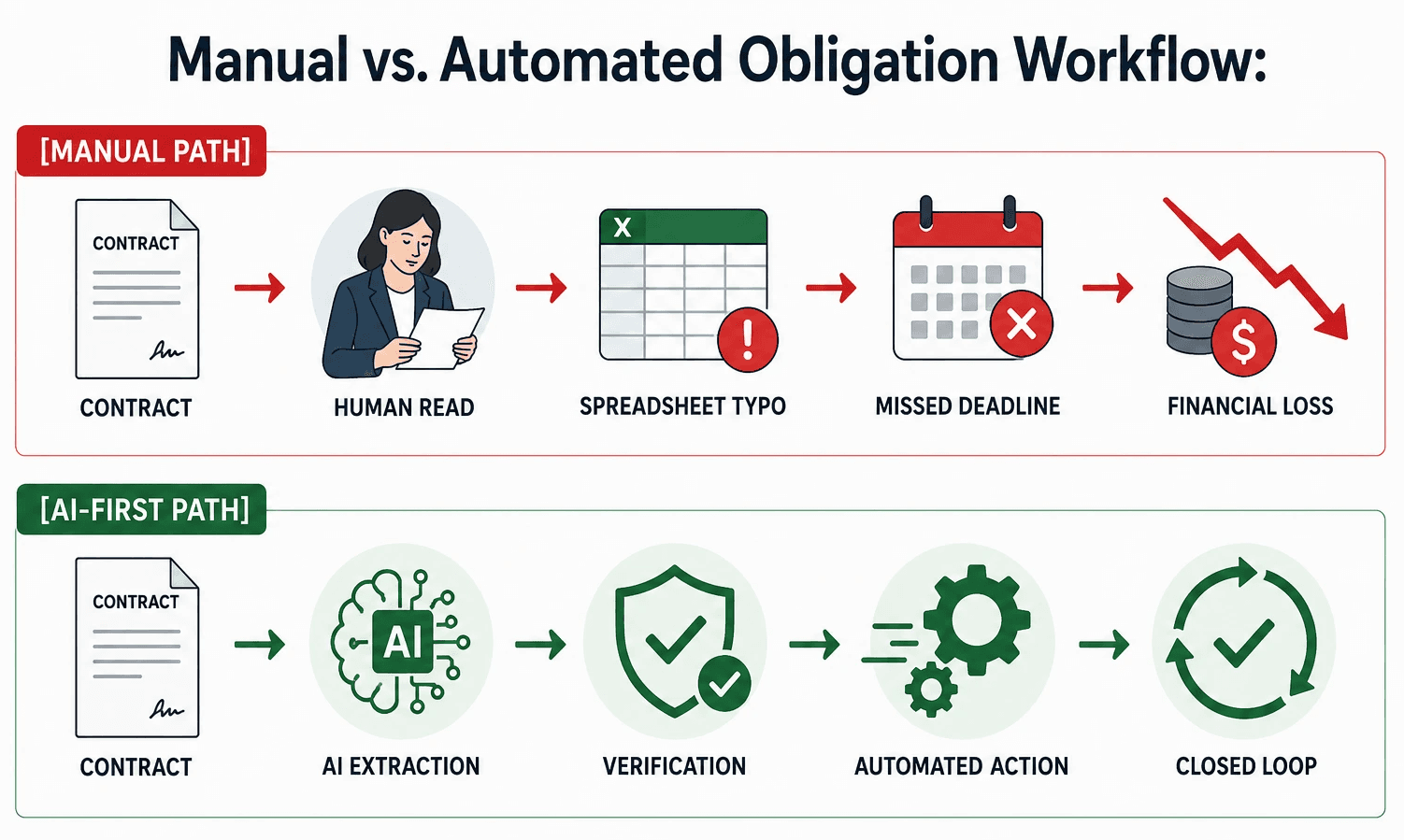
Manual tracking requires a human professional to read through hundreds of pages. The practitioner must locate the commitments. They must type key dates into a spreadsheet. This task is highly manual and prone to human error.
A standard corporate contract can run over sixty pages. If a legal operations workflow depends on humans to find and log these terms, mistakes will happen. A tired reviewer might miss an auto-renewal date. They might misinterpret a liability limit.
How costly are these manual oversight mistakes? Industry benchmarks show that manual data entry suffers from an average error rate of nearly ten percent. For a company managing five thousand active agreements, that rate is a disaster. It means hundreds of missed terms are waiting to trigger financial or legal trouble.
Related Article: Agentic AI 2026: How Autonomous Workflows Redefine Legal
Financial Erosion: Revenue Leakage and Missed Milestones
The direct consequence of manual failure is financial loss. This loss is commonly known as revenue leakage.
The World Commerce and Contracting association published a critical benchmark on this issue. Their research shows that poor contract management practices cost companies up to 9% of their total annual revenue. This is not a theoretical number. It is real cash bleeding from the balance sheet.
How does this leakage happen in practice? Consider a company with a procurement contract that guarantees a 5% volume discount once purchasing crosses a specific threshold. If the procurement system is blind to this milestone, the company keeps paying full price. The vendor is highly unlikely to point out the oversight.
Similarly, think about software auto-renewals. A corporate buyer might want to terminate an expensive SaaS subscription. The contract requires a written termination notice ninety days before renewal. If the calendar alert is set even one day late, the contract renews for another full year. The organization is forced to pay for a tool it does not want.
These financial losses are completely avoidable. Yet, they happen every single day because of manual tracking systems.
The Core Pillars of AI-Driven Obligation Management
Artificial intelligence has completely changed how enterprises handle post-signature compliance. Instead of relying on human eyes and stagnant spreadsheets, modern platforms use advanced technology to automate the process.
Intelligent NLP Extraction vs. Basic Keyword Search
Many legacy search engines claim to find obligations by searching for the word "shall" or "must." This basic keyword search is highly inaccurate. It creates too much noise.
What is the difference between keyword search and natural language processing (NLP)? Keyword search only looks for exact characters. In contrast, modern NLP understands the actual intent of the language.
For example, a clause might read: "Supplier will provide quarterly performance reviews upon request."
A basic keyword search for "shall" will miss this requirement. An NLP model trained on legal intelligence understands that "will provide" creates a binding obligation. It extracts the duty, categorizes the task, and sets a quarterly recurrence cycle automatically.
This intelligent AI data extraction is highly reliable. It reads the contract like an experienced lawyer. It identifies the parties, extracts the core commitments, and maps the relationships without human intervention.
Contextual Risk Scoring and Hierarchy Mapping
Not all obligations carry the same weight. A missed monthly progress report is a minor issue. A missed data breach notification window under GDPR is an existential crisis.
What happens when an AI system processes a contract? It does not just extract the terms. It runs a contextual risk assessment. It evaluates each obligation based on its potential liability, financial impact, and regulatory risk.
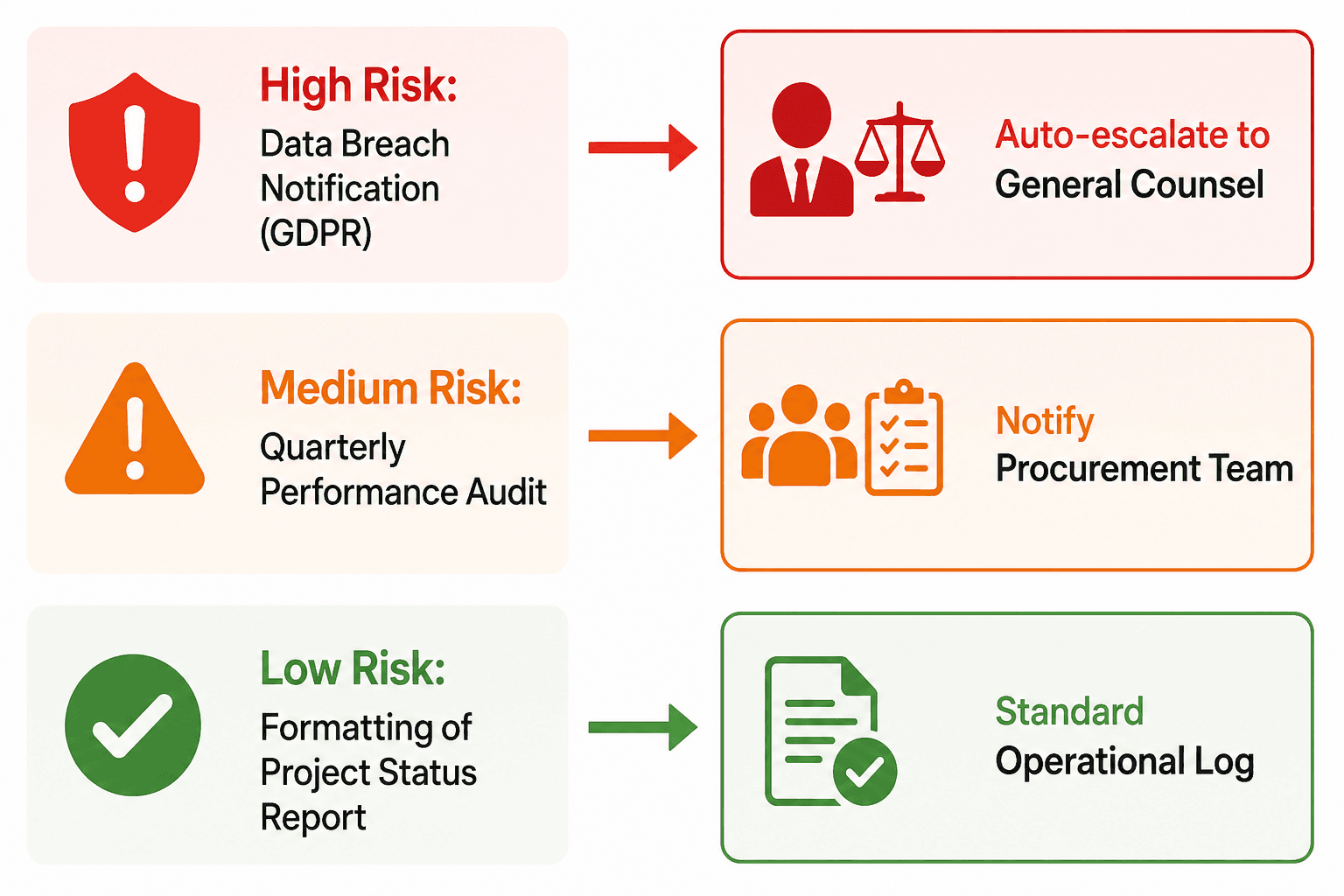
The system also maps clause hierarchies. It connects indemnification limits to payment obligations. If a vendor caps their liability at twelve times the monthly fee, the AI links these data points. This gives legal operations teams a clear, layered view of their true risk profile.
Related Articles: How to Use AI in Contract Drafting in 2026
Operationalizing Legal AI Teammates for Active Execution
The true future of legal operations is not just better dashboards. It is the transition from passive notifications to active execution.
Moving From Passive Alerts to Autonomous Actions
Most contract compliance software only sends an email reminder. An email notification does not solve a problem. It just adds to the inbox noise.
How can legal AI teammates drive real work to completion? They do this by executing the actual compliance task under human supervision.
Imagine an upcoming auto-renewal window for a non-performing vendor. A passive system sends an email alert saying: "Contract renews in 90 days."
An active AI teammate takes a different path:
It identifies the upcoming 90-day deadline.
It drafts a formal non-renewal notice using correct legal terms.
It presents the pre-drafted notice to the legal team for approval.
It sends the notice automatically once a human clicks "approve."
This approach closes the loop. It turns understanding into direct action. It handles routine, repetitive tasks so human lawyers can focus on strategic decisions.
Unified Multi-Document Due Diligence
Corporate legal teams rarely work with one single contract. Transactions involve hundreds of interrelated documents. This includes master agreements, statements of work, service level agreements, and amendments.
How does a legal team map compliance across a whole transaction? They cannot do it by reading documents in isolation. They need batch intelligence.
Modern systems use cross-file decision engines. These engines ingest thousands of contracts simultaneously. They extract commitments, cross-reference clauses, and flag contradictions across the entire document set.
If an amendment changes the payment terms of a master agreement from Net-30 to Net-60, the system updates the entire obligation map automatically. This ensures the compliance tracking layer remains perfectly accurate.
Related Articles: Top Legal AI Assistant for M&A Due Diligence Speed in 2026
Integrating Intelligence Directly Into the Legal Workflow
A legal tool is only useful if people actually use it. If a system requires users to log into a heavy, complex portal, adoption will fail.
Why Context Switching Kills Practitioner Efficiency
Lawyers and legal operations professionals live in Microsoft Word and email clients. Forcing them to jump between Word and a siloed CLM system is highly disruptive. This constant context switching wastes valuable time and introduces risk.
How do we solve this adoption problem? We do it by embedding legal intelligence directly into the daily workspace.
When a practitioner reviews or drafts a contract, they should see active compliance indicators directly inside Word. If they write a clause that conflicts with standard company playbooks, the system should flag it immediately. It should show alternative, pre-approved fallback language on the spot.
By bringing AI-driven insights directly into the workspace, organizations standardize contract compliance. Every team member reviews documents with the same high level of accuracy, regardless of their experience level.
How Lawxy AI Transforms Contract Obligations
Enterprise compliance requires tools designed for real-world legal operations. Tools like Lawxy AI solve this by deploying purpose-built modules that integrate with how legal teams actually work.
The platform replaces fragmented tools with a coordinated network of legal teammates. The Lawxy Contract Lens Word Add-in brings direct intelligence to the drafting phase. It extracts obligations, highlights risky clauses, and identifies deviations as you write.
For legacy portfolios, the Dino Intelligence Room operates as a cross-file decision engine. It processes thousands of corporate files and regulatory documents in minutes. It extracts key terms and identifies compliance risks across your entire contract collection.
To ensure these commitments are actively maintained post-signature, the Lawxy Obligation Management module shifts compliance from static spreadsheets to dynamic, always-on tracking. This specialized engine automatically converts complex contractual clauses into actionable line items, monitors critical operational milestones, and pushes real-time compliance alerts across business units. By centralizing visibility, it eliminates reactive firefighting and ensures the enterprise remains continuously audit-ready.
Once obligations are identified, the Lawxy AgentFlow System executes the necessary work. Specialized AI agents collaborate to manage tasks, verify compliance, and draft legal notices. This coordination occurs under strict human-in-the-loop control.
With modules like Contract Review Studio and the Smart Legal Intake Desk, Lawxy bridges the gap between legal departments and business operations. The result is an intelligence layer that stops revenue leakage, ensures regulatory compliance, and drives legal work to completion.
Frequently Asked Questions (FAQ)
What is contract obligation management in legal tech?
Contract obligation management is the post-signature process of tracking, monitoring, and executing the commitments agreed to in a contract. It ensures that both parties meet their deadlines, deliver deliverables, and adhere to compliance terms.
How does artificial intelligence extract contract obligations?
Artificial intelligence uses natural language processing (NLP) to read and understand legal text. Instead of searching for simple keywords, the AI analyzes the context and intent of clauses. It automatically identifies dates, payment terms, and performance rules.
Why do legal teams face revenue leakage without AI tracking?
Without automated tracking, companies miss critical contract milestones like volume discounts, pricing adjustments, or service level penalties. This leads to unclaimed credits, overpayments, and automatic renewals of unused, high-cost services.
What is the role of legal operations in obligation compliance?
Legal operations teams design the workflows, select the technology, and manage the processes that keep an organization compliant. They use AI systems to replace manual tracking spreadsheets with automated, scalable compliance models.
How do AI legal agents track post-signature milestones?
AI legal agents monitor contract data continuously. When a milestone approaches, the agent does not just send a notification. It prepares the necessary documents, drafts notices, and coordinates actions under human oversight to close the compliance loop.